
History of the Timepiece
This piece offers a rare opportunity to read history through a single watch.
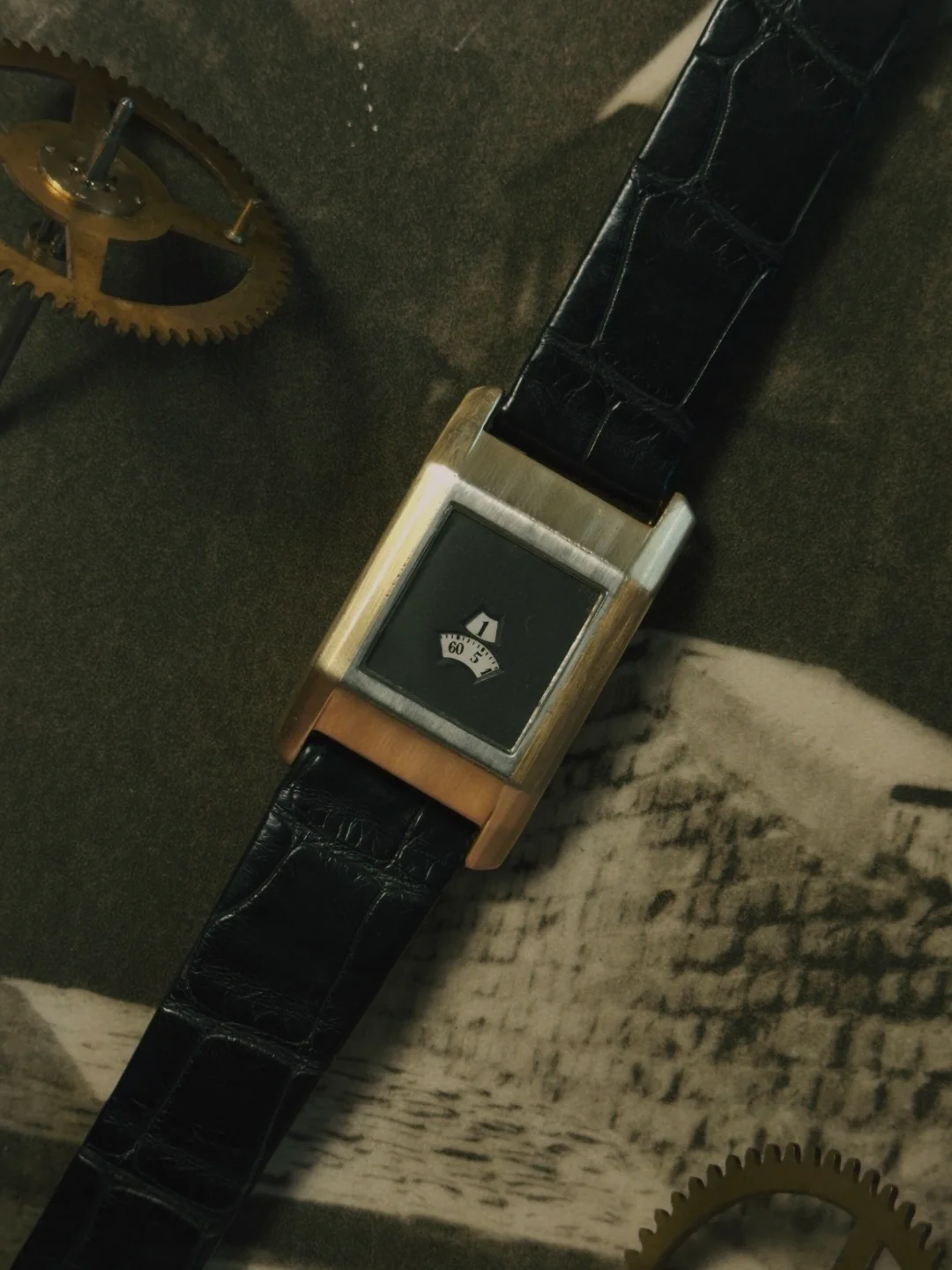
Presented here is an exceptional Blancpain, produced circa 1925.
Housed in an unusually large 18k solid gold rectangular case measuring approximately 30mm × 45mm, it stands apart from the conventions of its time.
Inside, it carries a rare configuration: a jumping hour display combined with an automatic winding system based on the Harwood patent—an early and historically significant approach to self-winding mechanisms, attributed to Léon Harwood.
What further distinguishes this piece is its documented verification.
To confirm its authenticity, the previous owner personally visited the Blancpain manufacture near Geneva, where a formal examination was conducted. As a result, official certification and archival records were obtained directly from the source.
Structure, history, and verification—
this is a timepiece that exists as a complete narrative.
We invite you to explore the origins of the Harwood automatic system, the context of its adoption, and the journey this watch has taken to the present day.
Not simply to own a watch—
but to experience the quiet luxury of owning time itself.

A mechanism defined by its structure.
At its core, an intermediate wheel transmits torque to the mainspring, while a fence—designed to match the dimensions of the case—guides a movable base lever.
As the watch moves vertically, the internal mechanism slides along this fence, activating the system.
A locking click mounted on the base lever, together with a fixed locking click, winds the intermediate wheel and transfers energy to the mainspring.
This construction can be described as a “lever up-and-down automatic winding system.”
By embedding ball elements into the sliding section, the mechanism was given the name “ROLLS.”
This system was developed by Léon Hart, who, under the concept of a “perpetual dream,” established his own workshop in 1911 at the age of 23 and achieved early success in watchmaking.
At the same time, John Harwood had already developed the first automatic wristwatch system.
In collaboration with the ébauche manufacturer A. Schild, the movement was adopted by Fortis and presented at Basel in 1926 as the world’s first automatic wristwatch.
Harwood later structured his business around licensing production and sales rights rather than direct manufacturing.
In 1926, Blancpain—then possessing exceptional financial strength—secured exclusive distribution rights across Europe, effectively dominating the automatic watch market.
Within this context, it is natural to consider that Hart’s mechanism became of strategic importance to Blancpain.
In 1929, Hart’s system was formalized as the “Hart Patent,” with its development and deployment overseen by Blancpain.

The present example is equipped with this Hart Patent automatic mechanism.
Originally developed in a ladies’ size, this system was later adapted into a men’s format through collaboration with Blancpain.
Today, no other confirmed examples are known to exist on the global market.
A defining feature of this watch is its jumping hour display.
The watch uses rotating discs for both hours and minutes, forming a counter-style display without traditional hands.
The hour indication advances in coordination with the minute disc, typically transitioning after the 40-minute mark— a characteristic behavior unique to this system.
The watch is fully automatic and, like the Harwood system, does not feature a crown.
Time-setting is performed by opening the case and turning a serrated internal lever by hand.
While case opening would normally introduce the risk of dust ingress, the integrated fence structure minimizes external entry points, leaving virtually no pathway for contamination aside from the setting lever itself.
A thoroughly considered construction.
Despite its technical ingenuity, the Hart system was eventually overshadowed by the Harwood design and disappeared from mainstream horological history.

This example is housed in a solid 18k yellow gold rectangular case.
With approximate dimensions of 28mm by 45mm, it represents an unusually large format for its time— exceeding even the proportions of the Rolex Prince.
The weight of solid gold, combined with the jumping hour display and the rare Hart automatic system, defines the presence of this piece.
The dial and all components remain in original condition.


Furthermore, to verify the authenticity of this particular instrument, the previous owner directly visited a factory near Geneva that is not even listed on maps, and conducted an investigation.
Located approximately two hours by train and then one hour on foot, the factory was directly contacted, and a formal confirmation was later received that the instrument was genuine and capable of being overhauled.
In addition, no similar instrument has been confirmed at the site, and it was reported to be the first time such an instrument had been seen.
A certificate and archive document issued by Blancpain headquarters are included with the instrument.
This is an extremely difficult instrument to verify the existence of.
With its structure, history, and verification process, this instrument possesses a complete story.


